Blog Feed

After Effects Design Challenge

Connecting, Synthesizing, Transforming—In addition to the source(s) provided, what other research was conducted to find success in this Design Challenge? How was the information applied and in what ways did it affect the outcome?

After Effects has many tools I did not know about. The most interesting I found in my videos would be the Null Object tool, though I cannot wait to play with After Effects more in the future to find more tools. I haven’t spent much time in Ae before today, I once create a scene with layers from Photoshop slowly turning on, but I didn’t really understand what Ae was for. I thought it was like photoshop of video, but I found it has a lot of motion as well as fixing video quality. I didn’t do any research outside of Adobe, their videos are very helpful.

Solving Problems—Outline your process (in detail) for having completed this Design Challenge. Did you produce multiple concepts before refining and finalizing your work?

I first started with the get to know video. This one was really boring, so I decided to skip ahead to something a little more complicated and fast paced. I did several videos in a few different areas, specifically, one about animating groups of layers, one about repairing video, and one about animating type. I found it so interesting that Ae has so many tools in many different areas of video editing. It makes sense, but learning the program has so many different tools to learn.

Innovative Thinking—In what ways have you subverted expectations through your approach to this Design Challenge? How do you measure the success of this project, and in what ways is it successful?

I measure my success by walking away feeling like I learned something useful and I became a better designer because of it. Here I really feel that way. Before starting, like I said before, I thought it was more like a photoshop of video, and I did learn some of that, but it was way more than that. I learned more than I expected in ways that will be very useful in my career.

Acquiring Competencies—Explain the tool(s), concepts, theory, and/or strategies that you learned by way of this Design Challenge. How will the information gained during this challenge be pulled forward into future projects and career?

During this design challenge I learned a lot of different tools. From assigning colors to label groups all the way up to refine edge tools and adjusting the paint stock on the timeline panel so it looks like it’s being painted in real time.

In my future projects, I can see this being used as cool effects for logos, social media advertisements, etc. Movement really catches the attention of a person scrolling.

Organizational Infographic

This week I was off work for the holidays, so I decided I really wanted to push my technical knowledge as far as I could. In researching infographics, I found a few cool motion graphic infographics. So I decided to make a motion graphic infographic on the motion graphics process. This really stretched my knowledge. Before today, I hadn’t touched any animation/video editing software since I learned about flash in 2013. I remembered a tween being the in between of a shape changing or a movement. And at that point the most we did was make a ball bounce. So, this was a difficult task to create in 7 days, but I am happy with the results.

For this, I followed the animation process we talked about. First I did a lot of research on motion graphic designers. I found a lot of similarities between motion designers and graphic designers. Some skills needed include principles and elements of design, typography, fundamental art skills, and the adobe creative cloud. Though the programs used for motion graphics include a few additional programs, After Effects, Premier Pro, and Animate. Many motion designers also use a few outside of the adobe creative cloud. Though for this project I strictly used the adobe creative cloud that comes with my student packages. After I collected information, I decided to illustrate the process of creating a motion graphics. From here I wrote a script/outline. Then storyboarded this. (https://youtu.be/BsroS2bcJWE)

From the storyboard I began creating the artwork. I started by drawing everything in illustrator and picking out a visual style. I decided to use a teal and gray color palette. Next I animated everything. This was the longest most difficult part. I gave myself two days, and I am so glad I realized we also had Monday yesterday because it was difficult to get the timing right and animate it all. I learned a lot though and next time it will go much smoother.

Here is the final video:

Research, Gathering Information, Connect & Synthesize data: Academic and Occupational, Conceptual

Develop a concept: Academic and Occupational, Conceptual

principles and elements of design, typography: Academic and Occupational, Conceptual

fundamental art skills(drawing, color theory, etc): Academic and Occupational, Conceptual/Technical

After Effects, Premier Pro, and Animate: Academic and Occupational, Technical

Storyboarding: Academic and Occupational, Technical

Effective Copywriting

This course was one I knew I was going to struggle with from the moment I signed up with Full Sail University, but I improved greatly and became more confident during the month. During this month I worked on the International Planned Parenthood Foundation. This non-profits goal is to help young women globally gain fundamental human rights. They provide young women with services including STI testing and treatment, birth control, cancer testing, and family planning. Through research I found it was important to focus on the stories of the women they help in order to appeal to their target audience.

The first step in this project was to determine who the target audience was. I developed personas that fit into the target audience. These included two personas, Sarah and Jonathon. Below I have attached their profiles.

After understanding the target audience, I created print advertisements for the campaign. I started by creating a mind map of who the organization is.

After brainstorming, i created 6 advertisement ideas based off of George Felton’s nine types of testimonials. (Felton, 2013) The first sketch was based on plain folks. the second was based on an employee. The third was based on using the wrong person. the 4th an expert.

The 5th example is based on plain folks again, but thinking about the target audience, includes a cell phone in the print advertisement. The 6th example uses a celebrity, shows her talking to a group, getting a group to right together. My last example has a photo from the women’s march a recent historical event that many women came out for to fight for women’s rights. This image evolves a memory of a time they wanted to do more, before going back to their jobs and forgetting about how much they want to help.

Above are my final advertisements. The first uses the historical example as Felton (2013) discusses. The second is plain folks, while the last is a doctor, or expert.

References:

Felton, G. (2013). Advertising: concept and copy. New York: W.W. Norton.

International Planned Parenthood Foundation. (2019). Retrieved from IPPF website: https://www.ippf.org/

Brand Vision Boards and SWOT Analysis

MODERN CULTURE
Bold – Progressive – Modern
Modern Culture Brand Definition
Key Value 1: creativity
Key Value 2: diversity
Key Characteristic 1: bold
Key Characteristic 2: modern
Its Differentiation: Diverse city with many modern artists and abstract architecture.
Experience / Emotional connection: Attending modern art museums and tasting fusion cuisine.

Design Rationale
Reykjavik’s culture is closely surrounded by its downtown with a large art community. The downtown has many beautiful buildings, from cathedrals to art museums. The culture logo is based on the Hallgrímskirkja church but approaches in a modern art format simply using line. The color palette uses a split complementary with a few adjustments, and tints of these colors. Orange, Green,  and blue are common colors of buildings in the city. The photos used in this brand are aerial city views.
TRADITIONS
Rugged – Noble – Honest – Nordic
Traditions Brand Definition
Key Value 1: honest
Key Value 2: noble
Key Characteristic 1: rustic
Key Characteristic 2: nordic
Its Differentiation: Reykjavik has a rich history of Viking descent. 
Experience / Emotional connection: A holistic connection to Viking heritage

Design Rationale
Viking heritage goes deep beyond beards. It has its own style, including wood textures and earth tones. The traditional brand embraces this style and grows upon it. The photos have low saturation views of the city, ocean, and mountains. The textures used are all rustic, paint chipping, ocean waves, and wood. The combination of all these elements have created a natural primitive style that represents the Vikings heritage.

References

Kratz, A. (2019, September 24). MDM530 Live Session Archives – Week 4. Retrieved from https://online.fullsail.edu/class_sections/46757/modules/180381/activities/1127121

Quast, L. (2013, April 15). How To Conduct A Personal SWOT Analysis. Retrieved from https://www.forbes.com/sites/lisaquast/2013/04/15/how-to-conduct-a-personal-s-w-o-t-analysis/#593b0e7928d8

Process

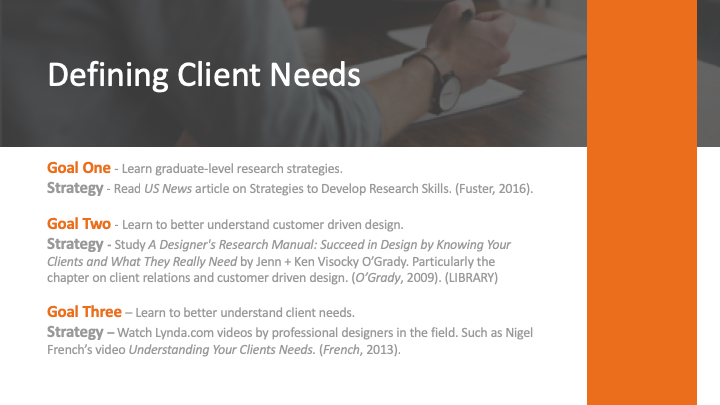
My graphic design process with practice has begun pretty straight forward, similar the top example on page 68 of A Designer’s Research Manual: Succeed in Design by Knowing Your Clients and What They Really Need, by Jennifer Visocky O’Grady and Ken O’Grady.

My process always starts with a commission, or a project being assigned.

Next, I begin in-depth research, looking to fully understand the problem. I use mind maps to connect ideas, writing down any relevant ideas/concepts/imagery. I look into target markets and competition.

I’m not really sure this is research or concept development, but I find it helpful to create personas that help me know who I am designing for in order to avoid accidentally making a design for myself.

Once I fully understand the problem and know who to target with my designs, I start to sketch out thumbnails. The ideas come from looking over my research. Looking over my sketches you can see how ideas develop. Many ideas are a not so great idea followed by something a little better as I synthesized ideas.

The first example is from culture, we can see how I synthesized the first idea of the cathedral from a shape into something more designed an abstract.

The second example is with the traditions, where I first was working with the R shape and how to design that in a Celtic style. The first idea was to simply have text below it, but instead, I realized I could make it a circle type.

The third is for geography, taking into account many of the reasons locals come to Iceland, I used the mountains and the northern lights as a concept. The first was in a circle, but then I realized the shape of Iceland may be cool.

Feedback by Yaminah Cummings:

Ryland chose to design his logos for the city of Reykjavik in Iceland. Before reviewing his designs, I read his synthesis and how he came about sketching the artwork for these designs. Ryland sketched work that symbolized Thor and the “Gods” at first glance you can tell these designs have a bit of a galaxy like theme also he talks about the cathedral. I can see that he did his research of the history in this city thoroughly, he then went to a concept of development. It seems he used a linear approach when creating these designs and he did a very good job at portraying this through his artwork.

I was immediately intrigued by these sketches, the logos told a story for themselves. He focused on one thing, the designs were simple but not too simple and offered some uniqueness. While these designs were very unique and different, just by looking at them I would relate them to many things such as Thor, galaxy, the “gods” however I wouldn’t immediately think of Reykjavik when seeing the logos. When creating new logos the intention is to grasp the targeted audience attention and promote awareness, sales, travel, or whatever the goal may be. Ryland designs were great and very unique but going forward I would suggest that he incorporated the entire city name to increase awareness and the audience knows exactly what the logo stands for.

2.1.2 Activity: Reflection on Week 1 of the Course

Live Video Session

The key takeaway from the week one live session with Ryan (McClang, 2019) is learning how to research at a graduate level. Learning to think like a graduate student. How to connect, synthesize, and transform ideas to write better papers and create better designs. Knowing how to connect, synthesize, and transform ideas is a skill that will transcend past writing papers, but into design work, as it translates into problem-solving skills. And as designers, it’s our job to solve problems clients present. 

I think my biggest concern going into this program at the moment is my writing skills. I am working to overcome this though, I use an app called Grammarly to check my grammar, and I am watching videos to better understand APA. I am an auditory learner, so reading textbooks has never been something I can do, and when writing once the words are on paper it’s hard for me to read them again and understand. But I have also found a feature in the vital source bookshelf that allows the book to be read to, while I use a feature inside of Microsoft Word that allows it to read my words back to me. These small things allow me to overcome though I still struggle and will work to do better.

Action Plan

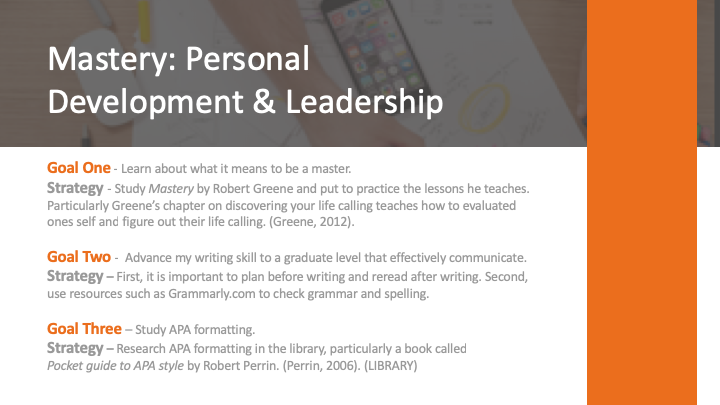
During this program at Full Sail University, I will grow as a graphic designer. Sean Adams (2017), says in the Lynda.com video, “I thought graphic design was about layout…but the turning point with me, was when I first got into art school…sudden(ly) it made sense, graphic design was about combing forms and ideas and images to make a new concept.” This reflects to “connect, synthesize, and transform” Sean’s college professor showed him a flag on a paintbrush. This concept was combing form and ideas, it connected art and America, and transformed the viewer’s ideas of both. My action plan for Full Sail to get better about this level of connection. I sometimes get there with projects, but I need to always get there so all my word is better than okay. I think what I have been missing is putting in the time and research, building the backbone to my designs.

To get to this level, I am going to spend at least 4 hours per day, 5 days a week on school research and projects for a total of 20 hours. I teach from 8 am – 11 am. I will take an hour break for lunch and commit at noon until 4 pm on my research and projects.

My long term goal as a professional media designer is to get a full-time college teaching position. Having examples of my documented research process will help me as a design teacher, to give examples of the entire process from beginning to end to help them understand how they can improve their processes.

References

Adam, S. (2017). What is Graphic Design? Retrieved August 7, 2019, from https://www.lynda.com/Graphic-Design-tutorials/What-Graphic-Design/614734-2.html?org=fullsail.edu

McClung, R. (2019). Week 1 Live Session. Retrieved August 7, 2019, from https://online.fullsail.edu/class_sections/46722/modules/173179/activities/1087779